
Case Study
World Bank Group
Next Generation Africa Climate Business Plan Report
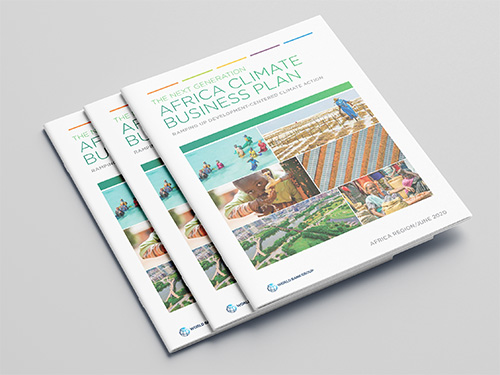
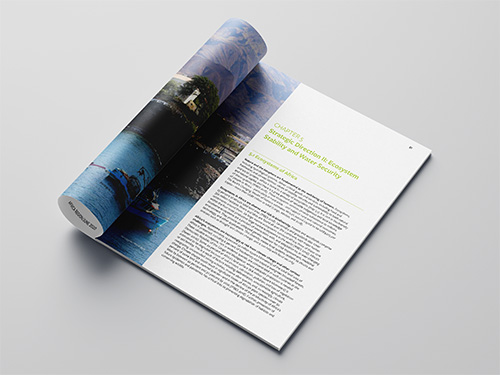
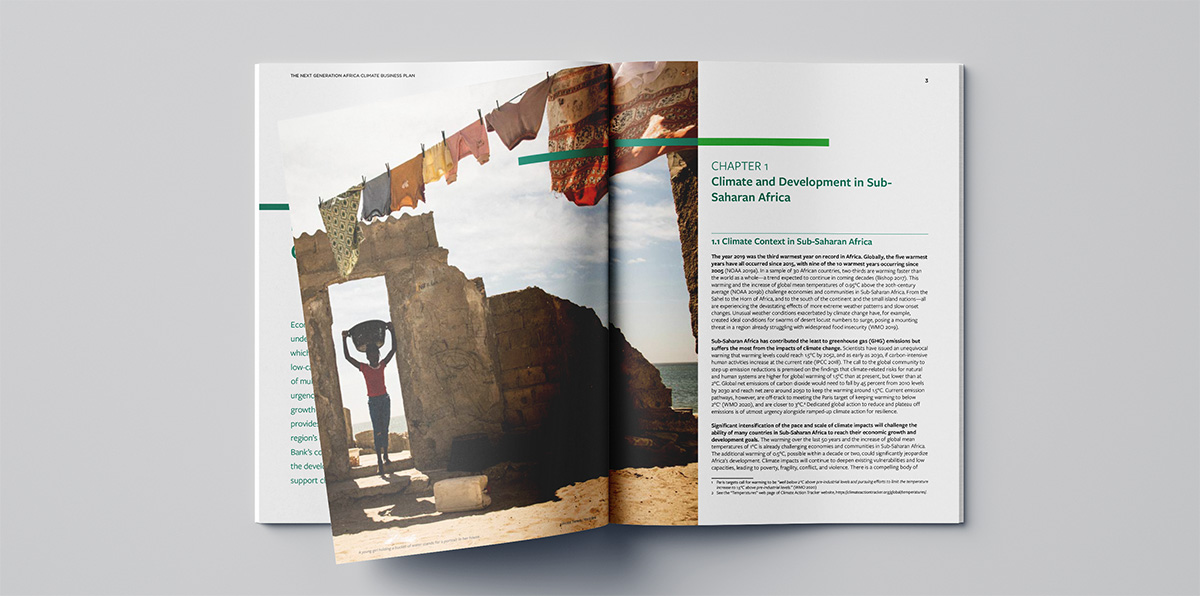
Served as lead designer on a 200-page global report, collaborating with a junior designer and creative director to translate complex climate data into an accessible, high-visibility publication. Directly covered by the World Economic Forum and Atlantic Council, and cited as a primary source by Al Jazeera and Brookings, the report was technically optimized for low-bandwidth global accessibility while balancing rigorous brand standards with the reach the subject matter demanded.
This was my first project for the World Bank Group, arriving shortly after my promotion to full Art Director at Owen Design. The stakes were high from the start — a 200-page flagship publication for one of the world’s most prominent institutional clients leaves little room for error. My creative director provided strong, considered feedback throughout, but gave me the latitude to drive the layout and design direction myself. That trust, early in my tenure, shaped how I approached the project: with the confidence to make real decisions and the accountability to back them up.
Extent: 203 Pages
Languages: English (Lead), French, Portuguese (adapted)
Optimization: Reduced from 118MB to <9MB for global accessibility
Core Tools: InDesign, Photoshop, Illustrator
The Foundation
I developed a robust, scalable document architecture from the ground up. I utilized advanced Paragraph, Character, and Object Styles to automate formatting across the entire document, ensuring 100% brand consistency while drastically reducing the margin for manual error during the design phase.
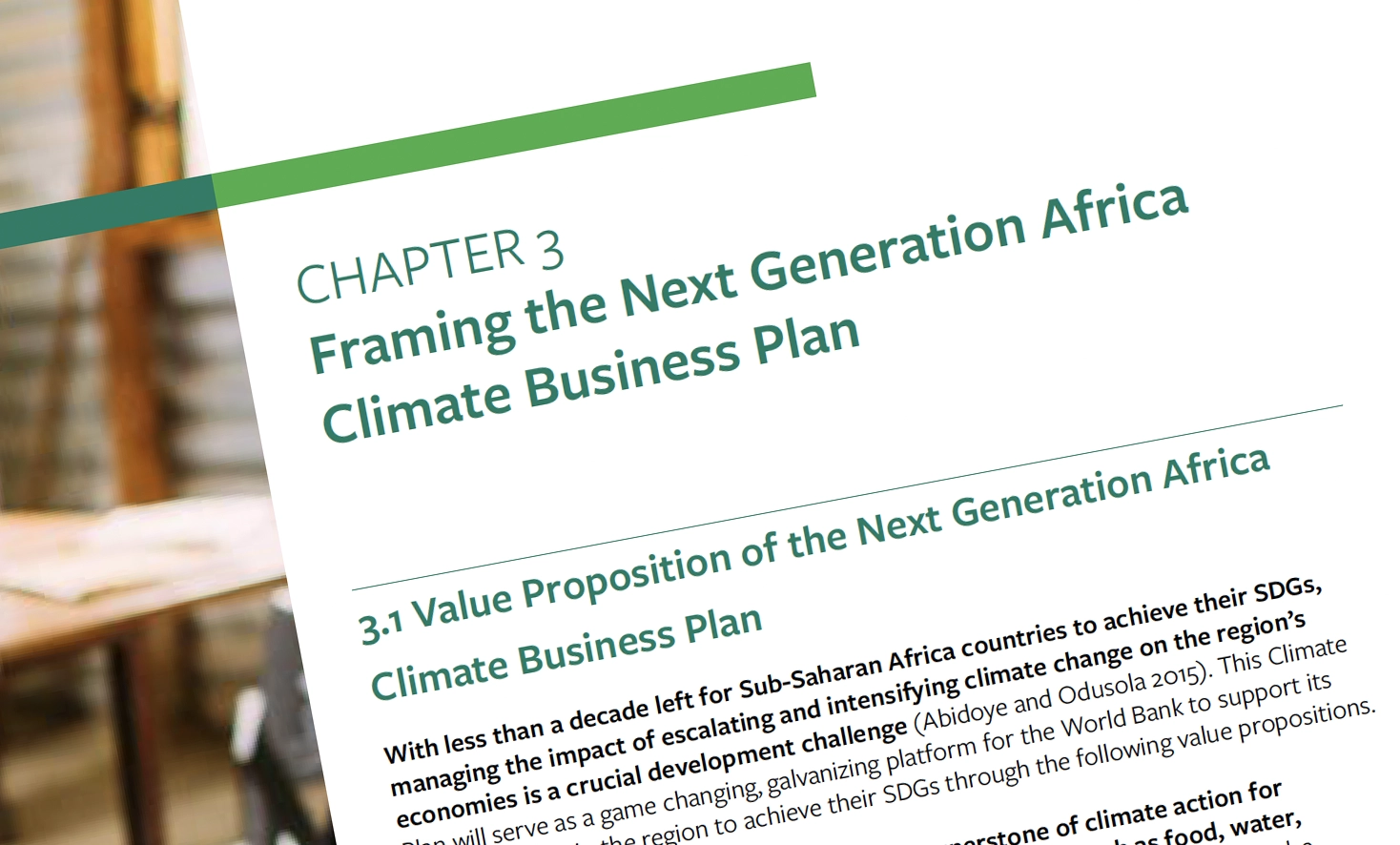
I also knew this document could be dense and — considering its subject matter — fairly bleak. I wanted the palette to allow the reader to release a little tension, while the imagery reminded them that at the center of all this data were people and communities simply trying to live their lives.
The Complexity
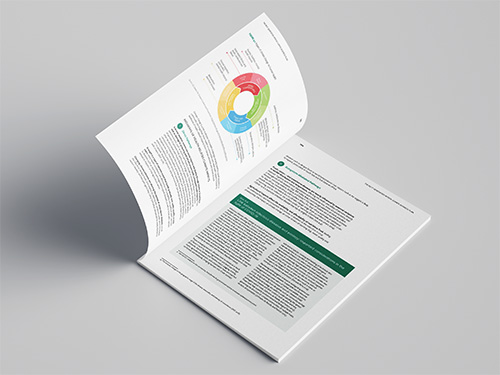
We received a trove of documents from the World Bank Group: source copy, maps we were expressly prohibited from altering, and Excel files that needed to be translated into charts and infographics. Because these elements were deeply interdependent, our design had to accommodate strict proximity requirements between specific visuals and their corresponding text.
The most significant technical challenge was a series of large tables appearing at the end of several chapters. The content volume demanded two-page spreads, but the tables couldn’t be split across a page turn. Rows varied wildly in structure, from six discrete cells to single lines of copy spanning the full width to bullet-pointed entries bleeding across all columns. Everything was interconnected, and breaking the flow would have cost the reader critical context.
There was also no single layout that served both formats cleanly: digital required visual clarity without a gutter, while print required the opposite. We resolved this by building two distinct versions of each table, one for print and one for digital, which meant our file management had to be meticulous at every stage, well beyond the usual CMYK/RGB distinction.

Digital Format

Print Format

The Impact
One of the final challenges we faced was in the final file delivery. We knew that this PDF needed to be accessible by people in areas with low connectivity. They could not afford to download a 100MB+ document. We needed to trim a 200 page document full of imagery down to under 10MB, while still retaining quality appropriate for a client like the World Bank Group.
We began by outputting individual pages, identifying our problem images that were bloating the file size. We optimized them one by one, and with a combination of that and PDF compression, we were able to reach a final online size of 8.3MB. Contrasted with the print PDF’s size of 118MB, this was a massive achievement, and a great way to increase global accessibility.


The report reached well beyond the World Bank’s immediate audience. It was directly covered by the World Economic Forum and Atlantic Council, and served as a primary source for reporting and research by Al Jazeera and Brookings. The document’s reach continued beyond my involvement: a 2023 update to the report, built on the same foundation, generated additional coverage across major outlets. While I had no hand in that version, its existence speaks to the lasting utility of the structure and design decisions made in the original.